
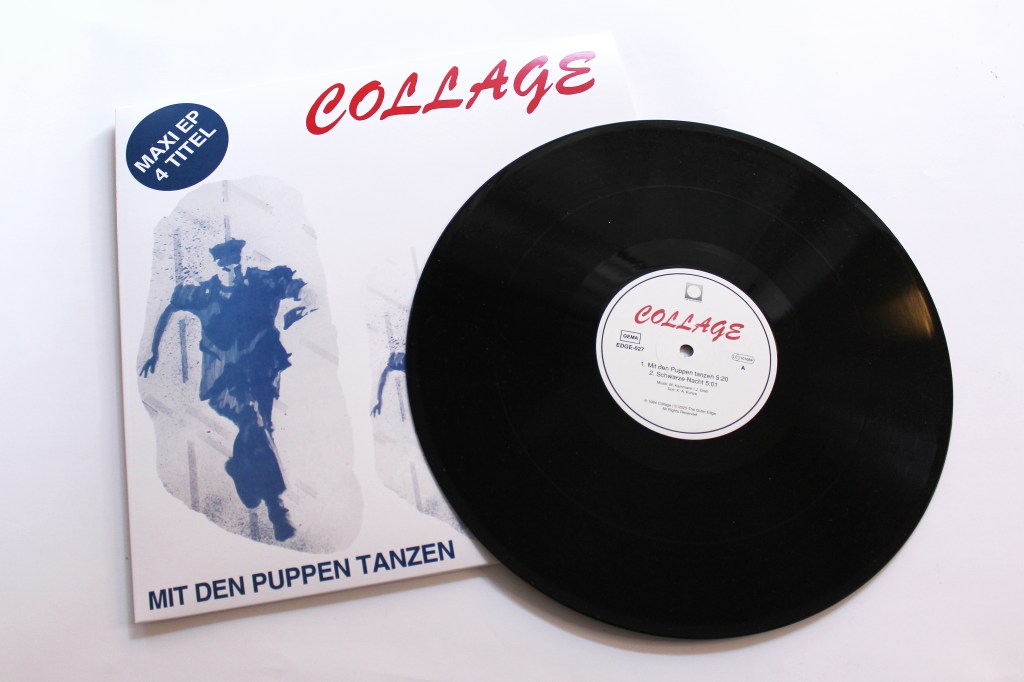
Interview: Markus Kammann of Collage, December 2024
The following interview was conducted via email in December 2024 to gather information for the release of the Mit den Puppen tanzen EP by Collage. It was not originally intended for publication. Kammann passed away unexpectedly in October 2025. He was not only a musician, but also one of the founders of the legendary Beat Box club in Wuppertal (1988 to around 1996), widely regarded as the first club in Germany to focus on modern club music from the UK and the US. Kammann also co-founded the first GrooveAttack record store (1990 to 1993).
Also note the interview with Kammann from May 2025 here
The Outer Edge: Where exactly are you from? Are you and your bandmates directly from Wuppertal?
Kammann: Katrin originally came from Cuxhaven, and she ended up in Wuppertal to study. Literary studies, with a focus on French literature.
Jürgen Grah and I, Markus Kammann, actually come from Solingen, the neighboring town to Wuppertal. I later got together with Katrin and moved to Wuppertal.
The Outer Edge: How and when did the Collage project come about? When did you meet Katrin?
Markus Kammann: Jürgen Grah and I formed a songwriting/composition team after previously playing in various bands.
The Outer Edge: Did any of you have a classical musical education?
Markus Kammann: No, we were more or less self-taught. Jürgen was mainly a drummer, but he could also play keyboards and vibraphone. Markus Kammann mainly played guitar and also bass.
The Outer Edge: On the Schwarze Bewegung project, your style was still clearly “Neue Deutsche Welle.” On the Collage EP, I already find the style quite unique — one could call it “Paranoia Electro Wave.” Through the scratching and some short rap parts, there is also a noticeable US influence. Which bands influenced you at the time for the record?
Markus Kammann: Schwarze Bewegung was clearly “Neue Welle”; at that time we still had a different singer. We then looked for alternatives and found Katrin in Wuppertal. She had sung in a New Wave band called “Hoch Tief.” We were influenced by Arthur Baker, producer for Tommy Boy Records, Afrika Bambaataa, etc. Kraftwerk becoming funky. Meaning electronics becoming dance music. Bambaataa’s “Planet Rock,” “Looking For The Perfect Beat.”
The Outer Edge: While with other electronic productions from Germany from that era, one often gets the feeling that people first had to learn how the equipment worked, the Collage EP sounds as if you were pulling it all effortlessly out of your sleeve — every track shines with details and inventiveness. Had you already pre-produced the songs? Or did some of the structures only emerge in the studio?
Markus Kammann: Other German productions were more influenced by Klaus Schulze, Kraftwerk, Tangerine Dream, etc. Black music is our musical background. Electro, soul, jazz.
The Outer Edge: How long did the studio work take? How did the contact with Studio Lambertz come about?
Markus Kammann: We had one week. The contact came about through Uwe Bauer (drummer) and Horst Lüdtge (manager of Fehlfarben). Uwe Bauer also did the cover artwork (Bimbo Art).
The Outer Edge: With Horst Luedtke from Profil, who mixed the record, you already had quite an experienced producer on board. How did it come to the small label F-Music? And how was the record received at the time?
Markus Kammann: Horst was only responsible for the mixing in the studio.
The Outer Edge: Why exactly 4 songs? Normally maxi singles with 2 songs were common. Was a full album planned like with Schwarze Bewegung?
Markus Kammann: We first wanted to make a 4-track EP.
The Outer Edge: How did you do the scratches? I assume NOT with turntables but rather using tape.
Markus Kammann: Tape.
The Outer Edge: Which drum machine did you use? Which other instruments did you bring with you?
Markus Kammann: We had a Roland TR-808 and a Roland Juno-60. In addition there was bass and guitar. Everything else was in the studio.
Lambertz had two self-built sequencer devices that could be triggered with the Juno-60. Sequencers were hardly in use back then. Also, our financial means were limited.
The Outer Edge: Why was the project put on ice? Were you also looking for a better deal with a larger label?
Markus Kammann: At the time we produced a soul album on an electro basis that was intended for a bigger label, but unfortunately it didn’t work out. (Editor’s note by The Outer Edge: Kammann was speaking of the album “Motel d’amour”, which we had not heard until then)
The Outer Edge: Did you also perform live?
Markus Kammann: No.
The Outer Edge: What came afterwards? After that there was the “Cold End” project…
Markus Kammann: We recorded another soul project in a studio in Northern Germany (Editor’s note: again speaking of “Motel d’amour) … Katrin’s husband gave me a cassette…
First came the soul album, which unfortunately was never released. Then came the Cold End project, which was the last thing produced in the studio in Northern Germany.
The Outer Edge: From many interviews and conversations with other artists, I keep hearing how much the music market at the time resembled a shark pool (“Haifischbecken” in German).
Markus Kammann: That’s still the case today. Bellaphon had hired a new A&R manager, but he had absolutely no backing within Bellaphon. But that’s nothing unusual — most A&R people have no idea about music. I met quite a few of them. At the beginning of the 1990s, A&R people were replaced by marketing people, because the dance styles represented a complete overload for them. Bellaphon completely missed the whole “Neue Welle.” Under those circumstances, the “Bazillus” sublabel was doomed to fail. Not much later, Bellaphon went downhill.
The Outer Edge: How did you experience that? What was your collaboration with Bellaphon like (for Schwarze Bewegung)? With Collage maybe you were simply a bit unlucky that the EP was not marketed well (that’s my assumption). And with the unreleased Collage album, maybe you simply no longer had what the A&Rs wanted at the time.
Markus Kammann: Collage was not marketed at all. Horst Lüdtge had left EMI and taken over management for Fehlfarben. Collage had been produced cheaply and distributed independently through EFA. Various major companies were interested in the Collage album. A&R jobs are ejector seats. They thought the album material was great because it was very different from the usual. First they said the hit single was missing, and in the end Polydor wanted the album for Inga Humpe (Editor’s note: sister of Annette Humpe of popular band Ideal), whom Polydor had already signed. But Inga Humpe had no songs. She had been the singer for Neonbabies. That would have pushed Katrin out, and we couldn’t go along with that. Later, Polydor made an album with Inga Humpe and her sister Annette called “Humpe Humpe.” (The band) Ideal made it possible. (Editor’s note: the album “Humpe Humpe” was released 1985 on WEA)
Here is a look into Lambertz Studio:

