
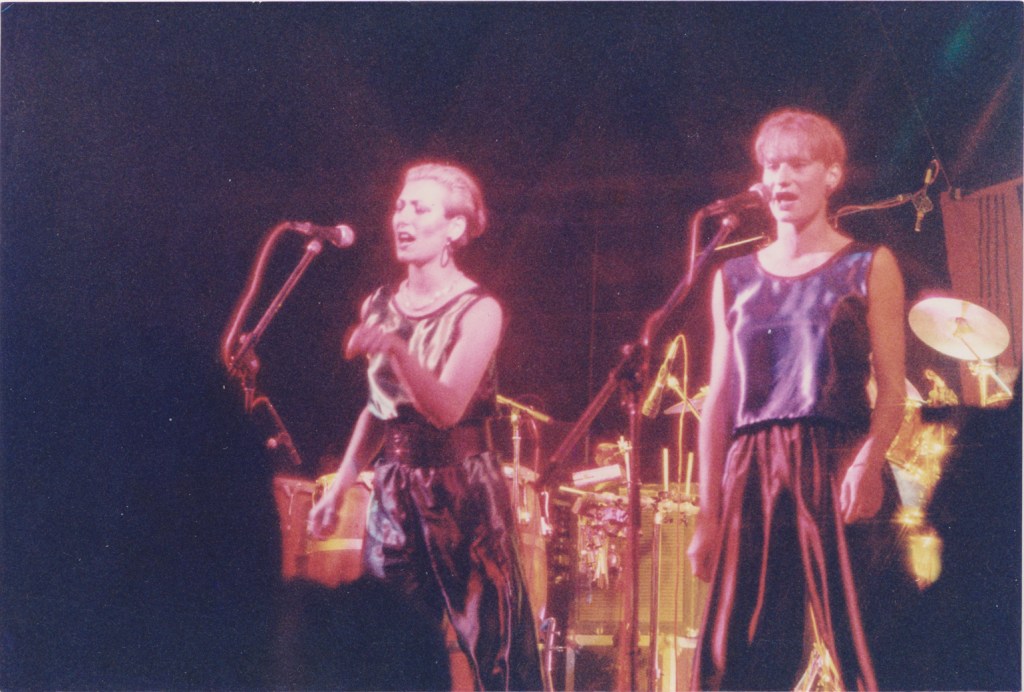
Foto: Andrea Weber and Katrin A. Kunze (of Siren Sisters). Courtesy of Markus Kammann.
Interview: Markus Kammann of Collage, May 2025
The following interview with Markus Kammann (of Collage, Cold End, Schwarze Bewegung, etc.) was conducted via email in May 2025 to gather information for the release of the Motel d’amour album by Collage. It was not originally intended for publication. Kammann passed away unexpectedly in October 2025. He was not only a musician, but also one of the founders of the legendary Beat Box club in Wuppertal (1988 to around 1996), widely regarded as the first club in Germany to focus on modern club music from the UK and the US. Kammann also co-founded the first GrooveAttack record store (1990 to 1993). The rest is history. A more extensive write-up will follow.
The Outer Edge: Did the idea for the lyrics mainly come from Katrin? That gives it something of a concept album feel. What would the album have been called back then? What did you call the project among yourselves?
Kammann: The lyrics are by Katrin! The album didn’t have a title yet, but I think we would have called it Motel d’amour, or something similar. That would have made sense.
The Outer Edge: The groove of “Rendezvous” reminds me a bit of “The Message” by the Furious Five. At times, Katrin’s delivery is almost like spoken-word or rap. Were you deliberately aiming in a rap direction, or did you still see it more as funk?
Kammann: Back then we listened to “Flash,” but also a lot of Earth, Wind and Fire, the Isley Brothers, the Brothers Johnson, the Commodores, and many American funk bands. I’ll send you a remake I did of “The Message.” I got it from the band that originally recorded the track, Tackhead.
The Outer Edge: The faster track “Wir haben getanzt heut Nacht” feels more like classic NDW. Was that something the producer wanted? Were there specific NDW bands that inspired you?
Kammann: “Wir haben getanzt” was indeed made with those NDW compromise vibes in mind. It was reworked later.
The Outer Edge: Would you be comfortable today describing most of the tracks as NDW electro-funk? You probably didn’t think much in terms of categories back then—but how did you present the album to labels? Simply as new wave?
Kammann: We would have described it as electro-funk with German lyrics. That would have been a unique selling point. Nobody else was doing that—most were still inspired by rock music.
The Outer Edge: One of the members of Art Programming—who also initially worked with a 808—once told me they deliberately switched drum machines in 1985 because the 808 sound no longer felt contemporary. Alongside the decline of the “German wave,” was that a reason for you to shelve the album after it wasn’t picked up?
Kammann: We also started using live drums, since Jürgen Grah is a very good drummer. We always had his Tama kit with us. Cold End also used the Tama. Other equipment included a Yamaha keyboard (for brass sounds), Roland Juno-60, vocoder, Micro Moog, Roland TR-808, Hohner D6 Clavinet, Fender bass, and a Telecaster.
The Outer Edge: You then repositioned yourselves with Cold End. What was your goal at that point? Were you working toward an album? And was Tam Tam your own label?
Kammann: Katrin and I registered the label TamTam Records and financed and produced the first Cold End maxi ourselves. We sold the pressing of 1,000 copies directly. But we didn’t have enough money to produce more material. Katrin moved into advertising as a copywriter. She worked for Grey Düsseldorf and later freelance for various agencies. Jürgen Grah and I initially worked in youth services. At the same time, I ran two clubs (Beatbox and 45 rpm), a concert agency, and currently two music projects: Robo Bass HiFi and Data Dreads. Unfortunately, we never managed to make a living from music, even though we were very committed and had good ideas.
The Outer Edge: I’m possibly planning another maxi release for Collage. Could we include “E.T.” as a bonus track, perhaps as Schwarze Bewegung meets Collage “E.T.”? Katrin sings on it as well…
Kammann: Yes, Thomas Kohl and Katrin both sing on it. But I would classify it under Collage. “E.T.” came about because the studio manager demanded that we “just produce a hit.” He obviously hadn’t managed to sell the material we had to a record company. We didn’t matter to him—his main concern was selling the tape. Sadly, Thomas Kohl is no longer alive either. Toward the end of his life, he really went all out. A wild finale.
The Outer Edge: Can you tell me why you didn’t continue with Schwarze Bewegung? Did you and Kohl simply have different projects and ideas? Did you prefer working with Katrin? Or were there plans to continue together, like on “E.T.”?
Kammann: Regarding Schwarze Bewegung: Bellaphon shut down the Bazillus label because they couldn’t handle promoting their NDW artists at all, and they fired the A&R manager responsible. His successor was at a disadvantage from the start, since he hadn’t signed the bands himself. For us, the project was over anyway, as NDW had already reached a complete sell-out phase. We wanted to oppose that with something different, especially since we were listening to other kinds of music as well. We remained on friendly terms with Thomas Kohl, though—that’s why “E.T.” turned into a duet. There was no grand concept behind it, more just a sense of fun.
Additional context (editor’s note regarding Motel d’amour): Studio: Detla Studio Wilster. Sound engineer: Richard Rossbach. Owner: Manfred Schunke. Schunke also tried to sell the tapes. At the time, he wasn’t able to place the material with major German labels. After the NDW wave, that was a difficult task.
The Outer Edge: Did you ever ask Schunke whether he still had the tapes?
Kammann: I don’t even know if he’s still alive. But I do know the studio was dissolved a long time ago. The tapes were disposed of. Schunke didn’t keep them at home.

Logo of Tam Tam records, founded by Markus Kammann and Katrin A. Kunze

