A Progressive Beat Mass Story
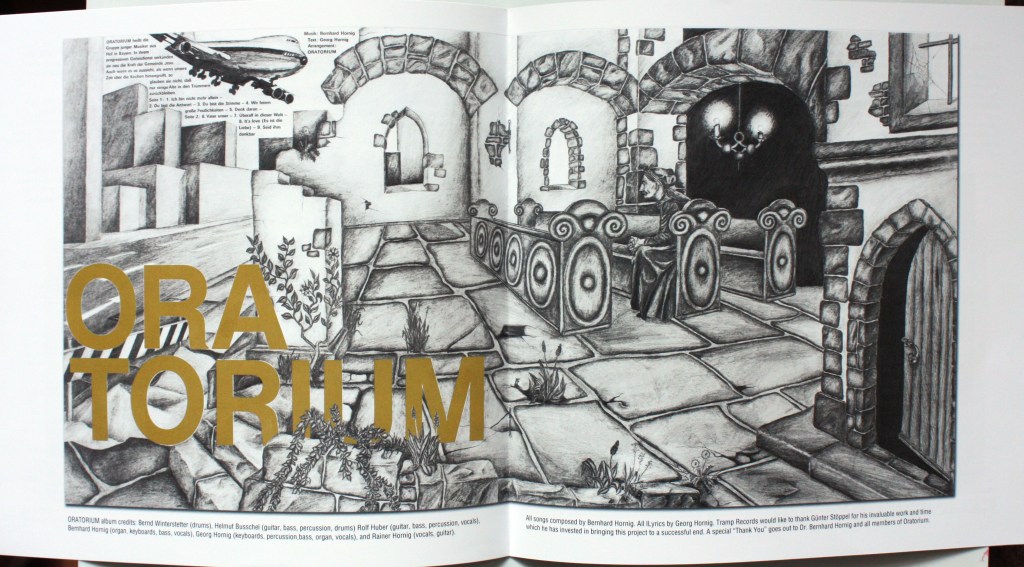
The 1972 self-titled debut album by German group, Oratorium, is one of those rare albums that is shrouded in a certain mystique. This is a record that invites you into a sacred and supernatural world, one of uncompromising religious progressive rock. This is the story of Oratorium, an immaculate conception in Krautrock history.
Led by composer Bernhard Hornig, the band was formed in 1967 under the name of Christian Unity in a small town in Bavaria called Hof. As Mr. Hornig recalls, the band was put together when his former school band fell apart. Three of the members were forced to repeat class at the end of the school year and as a result the band was summarily abolished by their parents. Undaunted, Hornig founded a new band with his two brothers Georg and Rainer as well as two friends from the original group. Perhaps as some sort of trick, their new focus was to be solely on religious music. Could their parents oppose them performing songs in the name of the lord? Certainly not!
Immediately, Bernhard Hornig began composing songs for a religious rock mass, the first of it’s kind. His concept took shape long before Jesus Christ Superstar made the rock-opera popular in Christian and secular circles. He and his brothers came from a musical family, and groups like Deep Purple, The Beatles, The Rolling Stones as well as soul music inspired them the most. Georg Hornig was responsible for the lyrics and mainly played the bass, the youngest brother Rainer, who had had vocal training as a member of the very famous youth choir Regensburger Domspatzen, took over the lead vocals.
On December 15th, 1968, the “first German Beat-Mass (Beatmesse)” debuted. The term “beat mass” was derived from the jazz masses which were popular during that time in Germany. As you can guess, the first provocative performance became reason for various disputes within the church and they were almost banned by the local bishop. Ultimately, all went well, and Christian Unity received official blessings to continue to play. In June of 1969, they contributed to the “Bamberger Diözesan-Beat-Festival” a festival organized by the church in Bamberg, a town near to Hof in Upper Franconia, Bavaria. They were the only group that performed self-composed, sacred music in the German language and performed songs from their 1st and 2nd beat mass. They were awarded 5th place in the competition, and were the only band recorded at the Bavarian broadcasting (Bayrischer Rundfunk) in Nuremberg.
Christian Unity began to blossom and Hornig finished composing a new, 2nd German beat mass in late June of 1969. The group partly consisted of up to 8 people and collaborated with a 20 person orchestra made up of teachers and pupils from three schools including the local symphony orchestra in Hof. Oratorium, as they were calling themselves now, became more popular and performed at local schools, diverse ecumenical events, as well as for the US armed forces.
Unfortunately, no recordings from those later orchestral works are available today. Oratorium was forced into early retirement as Bernhard Horning started his studies of veterinary medicine in another town. However, the legacy of Oratorium and their first and sole album was rekindled when another group from or around Paderborn, a city in eastern North Rhine-Westphalia, performed songs of Christian Unity in their community. As a result of the tribute, the leader of the influential Christian youth organization, KIM, Pater Lienhard, contacted the group. In 1971, KIM organized a tour of 15 churches in the North Rhine-Westphalia (NRW) area.
The tour ultimately led to the idea to record a vinyl LP. ASS (which means “ACE” in the German language) was a relatively new label from publishing company Hoppe & Werry that had already been involved in releases of early jazz masses in the mid 1960s in cooperation with the better-known religious label Schwann. They founded their own record company in 1970 and released a couple of quite progressive Free Jazz Christian music by Jazz Life Trio, a group from Switzerland. “Oratorium” seems to have been their first rock project, and a progressive one at that!
The recording of the album took 3 days during March of 1972 at the St. Konradskirche in Hof. The mass itself was presided over by youth padre Lienhard of KIM and was a glorious success. The album itself was as daring as it could get for a religious release! Unlike other Christian and religious albums of the time which always tended towards pop or amateurish rock, Oratorium was different; there was a serious, professional and progressive approach in their music. Songs were well arranged with rhythmic changes and thrilling organ performances. Rainer Hornung, who was only 18 years old at the time, floated above the orchestrations with a charismatic voice. Outstanding songs of the album are the opening title “Ich Bin Nicht Mehr Allein”, which was originally part of the first mass, as well as the epic “It’s Love”, a composition from the second mass.
In the original press sheet for the LP by ASS, Oratorium is described as “aggressive” and “haunting” (eindringlich) and asks: “A challenge for the guards of tradition?” (Eine Herausforderung für die Hüter der Tradition?). Perhaps this was a challenge to the old guard, but a unique challenge we have embraced wholeheartedly!
Of course, as goes many of the stories told here, the album didn’t get much coverage in the press and was poorly promoted. Sales figures of the album are not available, but it is quite sure that no more than 500 copies were ever pressed, it is even possible that just 300 were ever produced or sold. The original artwork is a non-glued folded sheet of paper which indicates that the pressing quantity was very low. Nevertheless, this underground rarity quickly became a collectable item within Krautrock circles when it was discovered.
The story of Oratorium did not end here. In 1973, they produced a double 7″ mini-album with 8 tracks called “Einsamkeit”. It was a concept release about the solitude of the young and old alike. It was released with a three year delay on Calig in 1976. “Einsamkeit” is different from their debut in that it starts with the progressive “I Feel Free” and then continues with mostly calm folkrock with beautiful and mature vocals. Though their early tendencies to relatively wild rock had faded towards acoustic guitar, this EP is certainly another collectable item for church rock aficionados.
As a last and very unpleasant note it should be mentioned that Lienhard was accused and found guilty three decades later of sexual harassment of altar boys in the late 1970s. The members of Oratorium themselves never noticed any of these deviances. Still, the youth padre’s involvement in organizing their tour and introducing them to Hoppe & Werry was the key to the production of the one and only true religious progressive rock album out of Germany.
We are honored to offer you this highly collectable self-titled album by the vanguard of German Xian rock. A veritable holy grail: Oratorium.
Written by John Raincoatman (2017)
Check these related promo mixes by DJ Scientist