
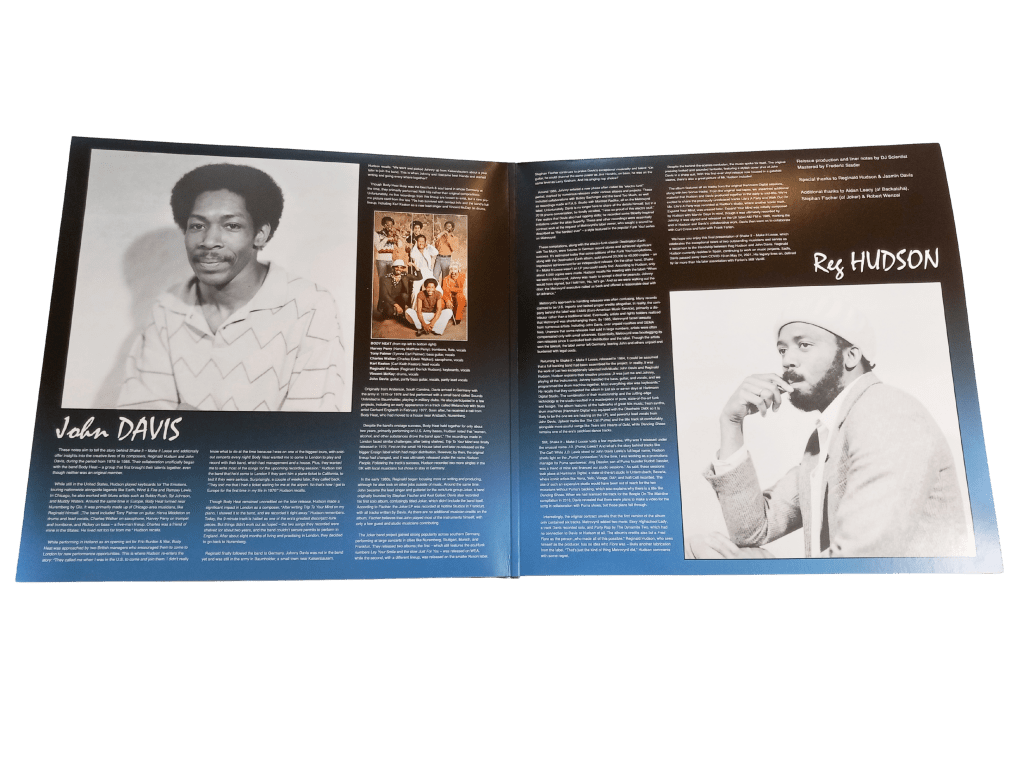
Linear Notes for Shake It Make It Loose
These liner notes aim to tell the story behind Shake It – Make It Loose and additionally offer insights into the creative lives of its composers, Reginald Hudson and John Davis, during the period from 1976 to 1985. Their collaboration unofficially began with the band Body Heat – a group that first brought their talents together, even though neither was an original member.
While still in the United States, Hudson played keyboards for The Emotions, touring nationwide alongside legends like Earth, Wind & Fire and Ramsey Lewis. In Chicago, he also worked with blues artists such as Bobby Rush, Syl Johnson, and Muddy Waters. Around the same time in Europe, Body Heat formed near Nuremberg by GIs. It was primarily made up of Chicago-area musicians, like Reginald himself. “The band included Tony Palmer on guitar, Herva Middleton on drums and lead vocals, Charles Walker on saxophone, Harvey Perry on trumpet and trombone, and Rickey on bass – a five-man lineup. Charles was a friend of mine in the States. He lived not too far from me.” Hudson recalls.
While performing in Holland as an opening act for Eric Burdon & War, Body Heat was approached by two British managers who encouraged them to come to London for new performance opportunities. This is where Hudson re-enters the story: “They called me when I was in the U.S. to come and join them. I didn’t really know what to do at the time because I was on one of the biggest tours, with sold-out concerts every night! Body Heat wanted me to come to London to play and record with their band, which had management and a house. Plus, they wanted me to write most of the songs for the upcoming recording session.” Hudson told the band that he’d come to London if they sent him a plane ticket to California, to test if they were serious. Surprisingly, a couple of weeks later, they called back. “They told me that I had a ticket waiting for me at the airport. So that’s how I got to Europe for the first time in my life in 1976!” Hudson recalls.
Though Body Heat remained uncredited on the later release, Hudson made a significant impact in London as a composer. “After writing Trip To Your Mind on my piano, I showed it to the band, and we recorded it right away,” Hudson remembers. Today, the 9-minute track is hailed as one of the era’s greatest disco/jazz-funk pieces. But things didn’t work out as hoped – the two songs they recorded were shelved for about two years, and the band couldn’t secure permits to perform in England. After about eight months of living and practising in London, they decided to go back to Nuremberg.
Reginald finally followed the band to Germany. Johnny Davis was not in the band yet and was still in the army in Baumholder, a small town near Kaiserslautern. Hudson recalls: “We went and picked Johnny up from Kaiserslautern about a year later to join the band. This is when Johnny and I became best friends and started writing and going every where together!”
Though Body Heat likely was the best funk & soul band in whole Germany at the time, they primarily performed R&B hits rather than original compositions. Unfortunately, no live recordings from this lineup are known to exist, but a rare promo picture card from the late ‘70s has survived with contact info and the band’s full lineup, including Karl Keaton as a new lead singer and Vincent McDay on drums.
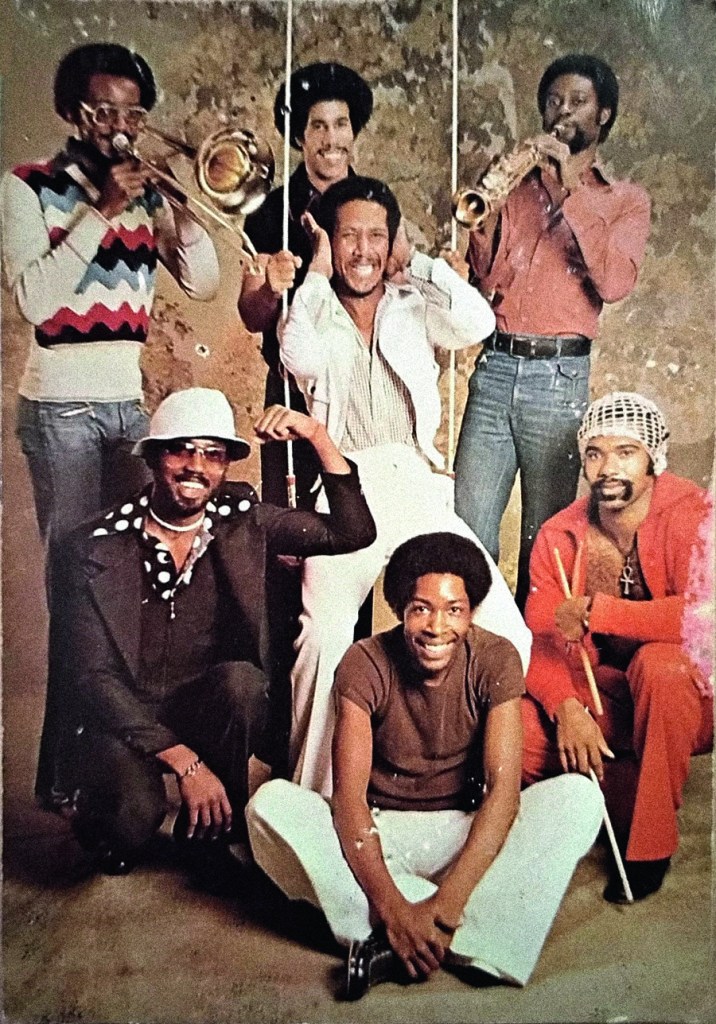
The Body Heat lineup (from top left to bottom right) included:
Harvey Matthew Perry: trombone, flute, vocals
Tony Palmer (Tyrone Earl Palmer): bass guitar, vocals
Charles Walker (Charles Edwin Walker): saxophone, vocals
Karl Keaton (Carl Keith Keaton): lead vocals
Reginald Hudson (Reginald Derrick Hudson): keyboards, vocals
Vincent McKay: drums, vocals
John Davis: lead guitar, partly bass guitar, vocals, partly lead vocals
Originally from Anderson, South Carolina, Davis arrived in Germany with the army in 1975 or 1976 and first performed with a small band called Sounds Unlimited in Baumholder, playing in military clubs. He also participated in a few projects, including an early appearance on a track called Melancholy with blues artist Gerhard Engbarth in February 1977. Soon after, he received a call from Body Heat, who had moved to a house near Ansbach, Nuremberg.
Despite the band’s onstage success, Body Heat held together for only about two years, primarily performing on U.S. Army bases. Hudson noted that “women, alcohol, and other substances drove the band apart.” The recordings made in London faced similar challenges;
after being shelved, Trip To Your Mind was finally released in 1979. First on the small Hit House label and later re-released on the bigger Ensign label which had major distribution. However, by then, the original lineup had changed, and it was ultimately released under the name Hudson People. Following the track’s success, Hudson recorded two more singles in the UK with local musicians but chose to stay in Germany.
In the early 1980s, Reginald began focusing more on writing and producing, although he also took on other jobs outside of music. Around the same time, John became the lead singer and guitarist for the rock/funk group Joker, a band originally founded by Stephan Fischer and Axel Golser. Davis also recorded his first solo album, confusingly titled Joker, which didn’t include the band itself. According to Fischer, the Joker LP was recorded at Hotline Studios in Frankfurt, with all tracks written by Davis. As there are no additional musician credits on the album, Fischer believes that John played most of the instruments himself, with only a few guest and studio musicians contributing.
The Joker band project gained strong popularity across southern Germany, performing at large concerts in cities like Nuremberg, Stuttgart, Munich, and Frankfurt. They released two albums; the first – which still features the soul/funk numbers Lay Your Smile and the slow Just For You – was released on WEA, while the second, with a different lineup, was released on the smaller Roxon label. Stephan Fischer continues to praise Davis’s exceptional musicality and talent: “On guitar, he could channel the same power as Jimi Hendrix, on bass, he was on the same level as Larry Graham. And his singing: top choice!”
Around 1983, Johnny entered a new phase often called his “electro-funk” period, marked by numerous releases under various aliases and projects. These included collaborations with Bobby Bachinger and the band Too Much, as well as recordings made at P.A.S. Studio with Manfred Radtke, all on the Metrovynil label. Unfortunately, Davis is no longer here to share all the details himself, but in a 2018 phone conversation, he fondly recalled, “I was so proud of this electro stuff.” Few realize that Davis also had rapping skills; he recorded some Blowfly-inspired imitations under the alias Superfly. These and other recordings were essentially contract work at the request of Metrovynil’s label owner, who sought a sound he described as “the hardest ever” — a style featured in the popular Funk You! series on Metrovynil.
These compilations, along with the electro-funk classic “Destination Earth” with Too Much, were fixtures in German record stores and achieved significant success. It’s estimated today that some editions of the Funk You compilations, along with the Destination Earth album, sold around 20,000 to 40,000 copies – an impressive achievement for an independent release.
On the other hand, Shake It – Make It Loose wasn’t an LP you could easily find. According to Hudson, only about 4,000 copies were made. Hudson recalls his meeting with the label: “When we went to Metrovynil, Johnny was ready to accept a deal for peanuts. Johnny would have signed, but I told him, ‘No, let’s go.’ And as we were walking out the door, the Metrovynil executive called us back and offered a reasonable deal with an advance.”
Metrovynil’s approach to handling releases was often confusing. Many records claimed to be U.S. imports and lacked proper credits altogether. In reality, the company behind the label was EAMS (Euro-American Music Service), primarily a distributor rather than a traditional label. Eventually, artists and rights holders realized that Metrovynil was shortchanging them. By 1985, Metrovynil faced lawsuits from numerous artists, including John Davis, over unpaid royalties and GEMA fees. Unaware that some releases had sold in large numbers, artists were often compensated only with small advances. Essentially, Metrovynil was bootlegging its own releases since it controlled both distribution and the label. Though the artists won the lawsuit, the label owner left Germany, leaving John and others unpaid and burdened with legal costs.
Returning to Shake It – Make It Loose, released in 1984, it could be assumed that a full backing band had been assembled for the project. In reality, it was the work of just two exceptionally talented individuals: John Davis and Reginald Hudson. Hudson explains their creative process: “It was just me and Johnny, playing all the instruments. Johnny handled the bass, guitar, and vocals, and we programmed the drum machine together. Most everything else was keyboards.” He recalls that they completed the album in just six or seven days at Hartmann Digital Studio.
The combination of their musicianship and the cutting-edge technology at the studio resulted in a masterpiece of pure, state-of-the-art funk and boogie. The album features all the hallmarks of great 80s music: fresh synths, drum machines (Hartmann Digital was equiped with the Oberheim DMX so it is likely to be the one we are hearing on the LP), and powerful lead vocals from John Davis. Upbeat tracks like “The Cat (Puma)” and the title track sit comfortably alongside more soulful songs like “Tears” and “Hearts of Gold,” while “Dancing Shoes” remains one of the era’s catchiest dance tracks.
Still, Shake It – Make It Loose holds a few mysteries. Why was it released under the unusual name J.D. (Puma) Lewis? And what’s the story behind tracks like “The Cat”? While J.D. Lewis stood for John Davis Lewis’s full legal name, Hudson sheds light on the “Puma” connection: “At the time, I was working as a promotions manager for Puma sportswear. Jörg Dassler, son of Puma founder Rudolf Dassler, was a friend of mine and financed our studio sessions.” As said, these sessions took place at Hartmann Digital, a state-of-the-art studio in Untertrubach, Bavaria, where iconic artists like Nena, Yello, Visage, DAF, and Soft Cell recorded.
The use of such an expensive studio would have been out of reach for the two musicians without Puma’s backing, which also explains why there is a title like “Dancing Shoes.” When we had licensed the track for the Boogie On The Mainline compilation in 2018, Davis revealed that there were plans to make a video for the song in collaboration with Puma shoes, but those plans fell through.
Interestingly, the original contract unveils that the first version of the album only contained six tracks. Metrovynil added two more: “Sexy Highschool Lady,” a track Davis recorded solo, and “Party Rap” by The Dynamite Two, which had no connection to Davis or Hudson at all. The album’s credits also list a “Fred Fiore” as the person “who made all of this possible.” Hudson, who sees himself as the producer, has no idea who Fiore was – likely another fabrication from the label. “That’s just the kind of thing Metrovynil did,” Hudson comments with some regret.
Despite the behind-the-scenes confusion, the music spoke for itself. The original pressing looked and sounded fantastic, featuring a stylish cover shot of John Davis in a sharp suit. With this first-ever vinyl reissue now housed in a gatefold sleeve, there’s also a great picture of Mr. Hudson included.
The album features all six tracks from the original Hartmann Digital sessions, along with two bonus tracks. From the original reel tapes, we unearthed additional material that Hudson and Davis produced together in the early to mid-80s. We’re excited to share the previously
unreleased tracks Life’s A Party and Walk Out On Me. Life’s A Party was recorded at Radtke’s studio, where another iconic track, Expand Your Mind, was created later. “Expand Your Mind” was initially composed by Hudson with Marvin Gaye in mind, though it was ultimately recorded by Johnny. It was signed and released on the UK label AM-FM in 1985, marking the end of Hudson and Davis’s collaborative work. Davis then went on to collaborate with Curt Cress and later with Frank Farian.
We hope you enjoy this final presentation of Shake It – Make It Loose, which celebrates the exceptional talent of two outstanding musicians and serves as a testament to the friendship between Reg Hudson and John Davis. Reginald Hudson currently resides in Spain, continuing to work on music projects. Sadly, Davis passed away from COVID-19 on May 24, 2021. His legacy lives on, defined by far more than his later association with Farian’s Milli Vanilli.
Written by Günter Stöppel, 2024

